The #1 Oven to Air Fryer Conversion Guide & Calculator
By Mary James
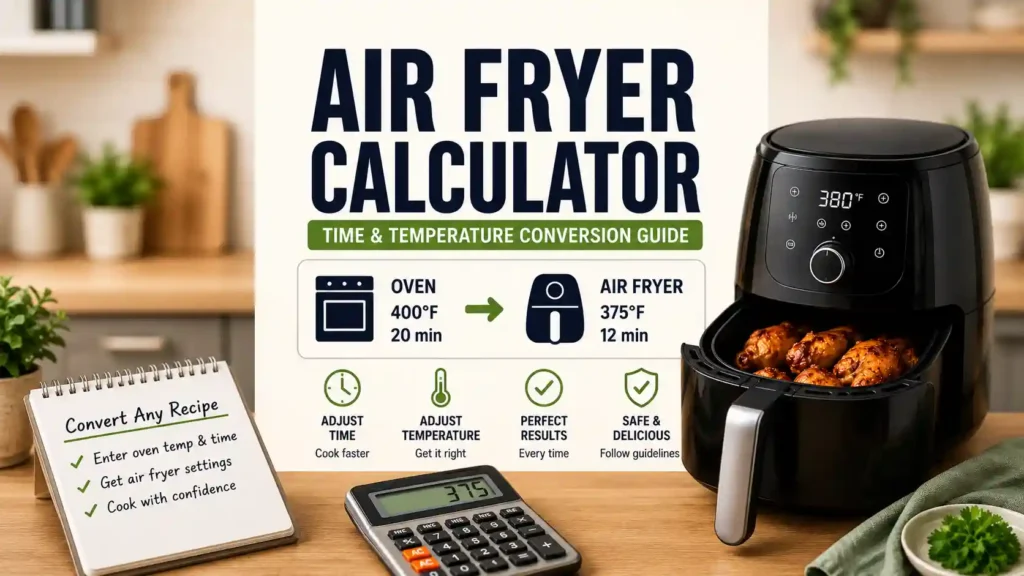
Converting an oven recipe to an air fryer is easy when you know how to adjust the cooking time and temperature. Use this oven to air fryer conversion guide and calculator to quickly find a practical starting point with tips for different foods, oven types and air fryer models.
Air Fryer Calculator
Use our advanced oven to air fryer converter for hassle free conversion of standard oven recipies into precise air fryer settings. This calculator has been calibrated dynamically for various food categories, oven types and air fryer types, so it gives you most accurate results which you can not expect from a simple calculator or chart or cheat sheet which give you just standard conversions without acoounting for various oven and air fryer types.
Advanced Oven to Air Fryer Calculator
Convert standard oven recipes into precise air fryer settings.
If you want to convert air fryer recipie into oven settings, use our Advanced Air Fryer to Oven Calculator.
How to Use Oven to Air Fryer Calculator
Our Advanced Oven to Air Fryer Calculator goes beyond the basic “subtract 25 degrees” rule. It uses dynamic algorithms to adjust for your specific food type and appliance brand.
Here is a step by step guide about use of each feature of the calculator for perfect results:
Step 1
Enter the Original Oven Temperature
Look at your original recipe and type the recommended baking temperature into the box. Use the convenient °F / °C toggle on the right side of the box to select your preferred metric.

Step 2
Input the Original Oven Time
Instead of forcing you to convert hours into minutes in your head, simply use the separate Hrs (Hours) and Min (Minutes) boxes. For example, if a recipe calls for 1 hour and 15 minutes, type “1” in the first box and “15” in the second.

Step 3
Select Your Food Category
Different foods react to the intense, rapid airflow of an air fryer in very different ways. Choose the option that best matches your meal:
- Standard Fresh: Best for raw vegetables, casseroles, and standard side dishes. It applies the standard 20% time reduction.
- Frozen Foods: Air fryers are incredible at rapidly thawing and crisping frozen foods without steaming them. This setting keeps the heat high but slashes the cooking time by up to 50%.
- Baking & Delicate Pastries: Because the heating element is so close to the food in an air fryer, the top of a cake or muffin can burn before the middle is baked. This setting applies a deeper temperature cut to ensure an even, golden bake.
- Poultry / Beef / Seafood: Select these if you are cooking raw meats. The calculator will automatically generate specific USDA food safety temperature guidelines in your results.

Step 4
Choose Your Air Fryer Type
Not all air fryers are created equal. Select the hardware style sitting on your counter:
- Standard Basket: The traditional baseline models (e.g., Philips, Gourmia).
- High-Efficiency (Runs Hot): Brands with dense heating coils that cook exceptionally fast and aggressively (e.g., Ninja, Cosori). The calculator will trim your time and temp slightly more to prevent burning.
- Large / Oven-Style: Larger appliances (e.g., Breville Smart Oven) have more space inside, which dilutes the hot airflow. The calculator will extend your cooking time slightly to compensate.

Step 5
Select the Original Recipe Oven Type
Check your source recipe. Was it written for a standard, traditional oven, or a modern fan-assisted (convection) oven? If the recipe already accounts for a convection fan, the calculator adjusts its math so you don’t end up undercooking your food.

Step 6
Click “Calculate”
Once you hit calculate, the screen will smoothly scroll down to your Optimal Air Fryer Configuration. You will get your exact target temperature, the newly calculated cooking duration, Formula Applied to calculate the result and a box of Expert Air Frying Tips tailored specifically to the food category you selected!


Oven to Air Fryer Conversion: Advanced Guide
Transitioning from traditional baking to rapid air circulation requires more than just guesswork; it requires a precise oven to air fryer conversion. Our calculator doesn’t use a “one-size-fits-all” approach. Our air fryer calculator is engineered using established thermodynamic baselines rather than simple estimations. Depending on what you are cooking and the specific appliance sitting on your kitchen counter, the algorithm automatically adjusts the math to prevent soggy bottoms, burnt crusts, or undercooked centers.
When you need to convert oven to air fryer instructions, the baseline rule of thumb is to reduce the target temperature by 25°F to 30°F and reduce the cooking time by approximately 20%. However, this oven to air fryer conversion calculator takes it a step further by factoring in the specific variables of moisture loss, appliance fan convection rates, and structural density. Whether you are looking to air fry in oven settings or need a precise convection oven to air fryer conversion, the math operates on a sliding scale to ensure your food’s exterior caramelizes perfectly without leaving the interior raw.
Here is exactly how the to convert oven instructions to air fryer instructions with real world examples:
| Cooking Scenario | What the Calculator Does | Why It Works | Real-World Example (Oven to Air Fryer) |
| Standard Fresh Food (e.g., Veggies, Chicken) | Temp: -25°F Time: -20% | Intense airflow cooks food faster and hotter. Dropping the temp prevents the outside from burning before the inside cooks. | Oven: 400°F for 20 mins ⬇️ Air Fryer: 375°F for 16 mins |
| Frozen Foods (e.g., Fries, Pizza Bites) | Temp: No change Time: -50% (Cut in half) | Dropping the temp makes frozen food steam and get soggy. High heat evaporates ice instantly, while the fan cuts cooking time in half. | Oven: 425°F for 20 mins ⬇️ Air Fryer: 425°F for 10 mins |
| Baking & Pastries (e.g., Muffins, Cookies) | Temp: -30°F Time: -20% | The harsh wind of an air fryer sets dough crusts too fast, stopping them from rising. A deeper temp drop allows the center to bake gently. | Oven: 350°F for 20 mins ⬇️ Air Fryer: 320°F for 16 mins |
| Convection Oven Recipes (Recipe already uses a fan) | Temp: No change Time: -10% | The recipe already accounts for a fan! We keep the temp the same but trim the time slightly because the air fryer basket is a smaller, more intense space. | Oven: 375°F for 30 mins ⬇️ Air Fryer: 375°F for 27 mins |
| “Hot” Air Fryers (e.g., Ninja, Cosori) | Temp: Drops an extra 10°F Time: Trims an extra 10% | These compact units have massive heating elements placed very close to the food. The calculator dials back the heat to prevent scorching. | Based on a 400°F / 20 min standard recipe: ⬇️ Hot Air Fryer: 365°F for 14 mins |
| Oven-Style Air Fryers (e.g., Breville, Cuisinart) | Temp: Adds an extra 10°F Time: Extends by 15% | Larger chambers dilute the hot air. Because the heat isn’t trapped in a tiny basket, the calculator bumps up the temp and time slightly to compensate. | Based on a 400°F / 20 min standard recipe: ⬇️ Oven Air Fryer: 385°F for 18 mins |
Oven to Air Fryer Conversion Chart
For those who prefer a quick visual reference over an interactive tool, this standard oven to air fryer time & temp conversion chart acts as a quick reference while you are in kitchen. Use this air frying chart to quickly convert cooking times and temperatures for standard meals and delicate pastries etc.

Gift for you: You may download and print this standard over to air fryer conversion chart in PDF format.
Note: As Oven to Air Fryer Conversion Chart gives you converted temp & time using standard settings without accounting for various oven types, air fryer types and food types, so it is my recommendation to use our Advanced Oven to Air Fryer Calculator which keeps all these parameters in mind and gives you the most accurate results which you can not expect from a simple chart or cheat sheet.
Air Fryer Cooking Chart/ Cheat Sheet
Use this handy air fryer conversion chart/ cheat sheet to quickly convert oven temperatures and cooking times into air fryer settings for a wide variety of foods and recipes like protein & frozen foods, vegetables & staples as well as baked food. This also includes guidelines to prevent any conversion mistakes; and USDA minimum internal temperatures guide for efficient cooking.
Oven to Air Fryer Conversion – Printable Cheat Sheet
Calculated using algorithmic baselines. Check food early.These paired settings use the standard algorithm: Subtract 25°F (15°C) from the oven temp, and reduce oven cooking time by 20%.
| Category | Food | Original Oven Recipe | Target Air Fryer Setup | Practical Note |
|---|---|---|---|---|
| Poultry | Chicken breast, boneless | 400°F / 25 min | 375°F / 20 min | Flip halfway; verify 165°F internal. |
| Poultry | Chicken thighs, bone-in | 425°F / 40 min | 400°F / 32 min | Skin side up for maximum crisping. |
| Poultry | Chicken wings | 425°F / 35 min | 400°F / 28 min | Shake basket vigorously halfway through. |
| Poultry | Whole chicken, 3-4 lb | 400°F / 75 min | 375°F / 60 min | Place breast-side down first, flip halfway. |
| Beef | Ribeye steak, 1 inch | 425°F / 15 min | 400°F / 12 min | Rest 3 minutes before slicing. |
| Beef | Hamburger patties | 400°F / 20 min | 375°F / 16 min | Cook to 160°F minimum internal. |
| Pork | Pork chops, boneless | 400°F / 20 min | 375°F / 16 min | Do not overcook; rest 3 minutes. |
| Pork | Bacon, regular cut | 400°F / 15 min | 375°F / 12 min | Drain grease if cooking multiple batches. |
| Seafood | Salmon fillet, 1 inch | 400°F / 15 min | 375°F / 12 min | Cook until flaky and opaque. |
| Seafood | Shrimp, fresh | 400°F / 10 min | 375°F / 8 min | Avoid overcooking; turns rubbery fast. |
| Vegetables | Broccoli / Cauliflower | 400°F / 20 min | 375°F / 16 min | Do not overcrowd basket. |
| Vegetables | Brussels sprouts, halved | 400°F / 25 min | 375°F / 20 min | Toss with a light oil spray first. |
| Potatoes | French fries, fresh cut | 425°F / 30 min | 400°F / 24 min | Soak in water first, dry thoroughly. |
| Potatoes | Baked potato, whole | 400°F / 50 min | 375°F / 40 min | Prick with fork; rub with oil and salt. |
| 1 | Use -25°F and -20% time as your baseline starting estimate for fresh foods. |
| 2 | Air fryers require very little preheating compared to ovens. 2-3 minutes is plenty. |
| 3 | Expect much faster, more aggressive browning due to the high-velocity fan. |
| 4 | Check your food 3 to 5 minutes before the timer ends. Air fryers are unforgiving! |
| 5 | Never overcrowd the basket. The air must circulate 360-degrees around the food to crisp it. |
| 6 | Shake the basket or physically flip the food halfway through the cooking duration. |
| 7 | Secure lightweight foods (tortillas, spinach) with toothpicks so the fan doesn’t blow them into the coil. |
| 8 | Use a light mist of oil for crispiness, but avoid aerosol sprays with propellants that damage non-stick coatings. |
| 9 | If your oven recipe was for a “Convection/Fan Oven”, keep the temp the same and only cut the time by 10%. |
| 10 | For meat, poultry, and fish, always verify internal temperature rather than relying on the timer alone. |
Oven to Air Fryer Conversion – Printable Cheat Sheet
Calculated using algorithmic baselines. Check food early.Frozen Algorithm: Keep Temp Same, Cut Time by 50%. | Baking Algorithm: Cut Temp by 30°F, Cut Time by 20%.
| Category | Food | Original Oven Recipe | Target Air Fryer Setup | Practical Note |
|---|---|---|---|---|
| Frozen | Frozen French fries | 400°F / 24 min | 400°F / 12 min | Shake the basket twice during cooking. |
| Frozen | Chicken nuggets / Tenders | 400°F / 16 min | 400°F / 8 min | Do not thaw first; cook straight from frozen. |
| Frozen | Mozzarella sticks | 425°F / 12 min | 425°F / 6 min | Watch very closely to prevent cheese blowout. |
| Frozen | Pizza rolls / Bites | 425°F / 14 min | 425°F / 7 min | Let cool for 2 mins before eating to avoid burns. |
| Baking | Chocolate chip cookies | 350°F / 12 min | 320°F / 10 min | Line basket with parchment; leave space. |
| Baking | Brownies, in pan | 350°F / 30 min | 320°F / 24 min | Ensure baking pan fits without blocking airflow. |
| Baking | Muffins | 375°F / 20 min | 345°F / 16 min | Silicone cups work best in air fryers. |
| Baking | Canned biscuits/rolls | 375°F / 15 min | 345°F / 12 min | Deeper temp cut prevents the tops from burning. |
| Situation | Algorithmic Adjustment | Why? |
|---|---|---|
| Frozen Foods | Temp: -0°F (Keep Same) Time: -50% (Cut in half) | Dropping the temp causes steaming. High heat ensures rapid sublimation of surface ice. |
| Baking & Pastries | Temp: -30°F (-20°C) Time: -20% | The heating element is inches from the food. A deeper temp cut prevents the top batter from burning before the crumb sets. |
| Convection/Fan Recipe | Temp: -0°F (Keep Same) Time: -10% | If the oven recipe already accounts for a fan, the thermodynamics are similar to an air fryer. |
| High-Efficiency AF (Ninja) | Temp: Subtract extra 10°F Time: Subtract extra 10% | Brands with dense heating coils cook exceptionally fast and aggressively. |
| Large / Oven-Style AF | Temp: Add 10°F to baseline Time: Add 15% to baseline | Larger internal cavities dilute the airflow, meaning they take slightly longer to cook. |
| Food Category | Minimum Safe Temperature | Important Notes |
|---|---|---|
| Poultry | 165°F / 74°C | Applies to all chicken, turkey, and duck (ground or whole). |
| Ground Beef / Pork | 160°F / 71°C | Burgers, meatloaf, and sausages. |
| Whole Beef / Pork Cuts | 145°F / 63°C (+ 3 min rest) | Steaks, chops, and roasts. Resting is mandatory to kill pathogens. |
| Fish / Shellfish | 145°F / 63°C | Flesh should be fully opaque and flake easily with a fork. |
Gift for you: Download the Complete Air Fryer Cheat Sheet in PDF format for quick reference.
The Physics of Convective Thermodynamics
To truly understand how to convert conventional oven instructions to air fryer settings, you have to look at the physical science of heat transfer. Traditional static ovens rely on radiant heat from stationary elements. This process is notoriously slow at transferring energy to the surface of your ingredients.
Air fryers, conversely, act as miniature convection wind tunnels. The fundamental principle governing this is convective heat transfer, represented formally by Newton’s Law of Cooling and Heating:
q = h · A · (Ts – T∞)
where
q (Heat Transfer Rate): How quickly the total heat is transferred to your food (which dictates how fast it cooks).
h (Convective Heat Transfer Coefficient): How aggressively the air is moving. In an air fryer, the high-speed fan makes this number much higher than in a regular oven.
A (Surface Area): The total outside area of the food exposed to the hot air. (This is why spreading food in a single layer cooks it faster).
Tₛ (Surface Temperature): The current temperature of the food’s exterior.
T∞ (Ambient Temperature): The temperature of the hot, circulating air inside the air fryer basket.
In this equation, the high-velocity fan aggressively increases h (the convective heat transfer coefficient), forcing thermal currents downward and cyclically around the perforated basket. This violent airflow strips away the cold boundary layer of air surrounding the food. As a result, the Maillard reaction—the chemical process between amino acids and reducing sugars—accelerates drastically. This is why standard baking to air fryer conversion requires lowering the air fryer temperatures; the exponential increase in energy transfer will burn the exterior of the food long before the core reaches a safe temperature if traditional oven settings are used.
Air Fryer Troubleshooting: Fixing Burnt, Dry or Uneven Food
Even with an accurate oven to airfryer converter, users occasionally encounter real-world culinary hurdles. If your air fryer temps and times seem off, use this diagnostic matrix to correct your course and achieve the perfect cook.
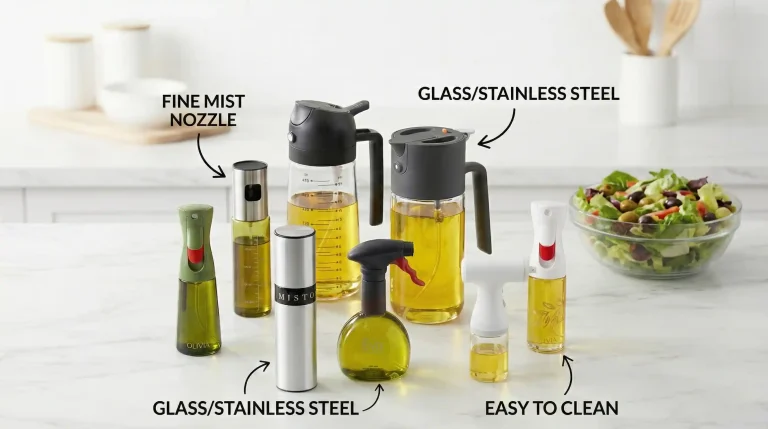
A light mist of oil is the cheapest sticking insurance — and if your mister is sputtering instead of misting, our oil sprayer fixes bring it back.
| Culinary Outcome | Underlying Cause | Corrective Action & Recommendation |
| Exterior is burnt; interior is raw. | Convective temperature is too high, causing surface sugars to caramelize prematurely. | Reduce the target temperature by an additional 15°F (10°C) and extend the cooking duration by 3-5 minutes. |
| Food is exceedingly dry or tough. | Excessive moisture loss due to rapid air circulation and overcooking. | Inspect the food 3-5 minutes prior to the timer concluding. To retain moisture without harsh chemical propellants, use a reusable, non-aerosol aluminum pump sprayer to apply a light, even mist of oil prior to cooking. |
| Asymmetrical or uneven browning. | Basket is overcrowded, effectively blocking the high-velocity airflow required for frying. | Cook ingredients in smaller batches utilizing a single layer. Vigorously shake the basket exactly halfway through the cycle. |
Four Essential Steps for Safe Food Handling
To prevent foodborne illness from undetectable bacteria, follow these four core safety rules:
- Clean: Wash hands and surfaces frequently.
- Separate: Keep raw meats away from other foods.
- Cook: Use a food thermometer to verify items reach their minimum safe internal temperature before removing them from the heat.
- Chill: Refrigerate perishables promptly.
(Note: You can always cook food longer or to higher temperatures based on your personal preference.)
USDA Safe Internal Temperatures
Because air fryers heat the exterior of food so rapidly, a piece of protein may visually appear perfectly cooked while the internal cellular structure remains dangerously under-pasteurized. Relying on an air fryer timing chart is only half the equation; verifying the internal temperature is critical for food safety. The table below outlines the strict USDA safe minimum internal temperatures you must hit when converting oven to air fryer recipes.
| Food Category | Minimum Safe Internal Temp | Resting Protocol |
| All Poultry (breasts, whole bird, legs, thighs, wings, ground poultry) | 165°F (74°C) | No rest required; serve immediately upon reaching temperature. |
| Beef, Pork, Veal & Lamb (steaks, chops, roasts) | 145°F (63°C) | Mandatory 3-minute structural rest period before carving. |
| Ground Meats (Beef, Pork, Veal, Lamb) | 160°F (71°C) | No rest required. |
| Ham, fresh or smoked (uncooked) | 145°F (63°C) | Mandatory 3-minute rest period. |
| Fully Cooked Ham (to reheat) | 140°F (60°C) for USDA-packaged; 165°F (74°C) for others | No rest required. |
| Fish & Shellfish | 145°F (63°C) | Cook until flesh is opaque and flakes easily with a fork. |
| Eggs | 160°F (71°C) | Cook until yolk and white are firm. |
| Leftovers & Casseroles | 165°F (74°C) | No rest required. |
Conclusion
Surpassing basic guesswork requires a fundamentally superior approach to culinary technology. Standard guidelines that merely subtract 25 degrees and trim 20 percent of the time rely on an overly simplistic mathematical baseline. Our advanced oven to air fryer conversion guidelines, calculator & charts offers objectively superior utility by processing the variables that dictate real-world culinary outcomes-from the delicate temperature curves required for pastry baking to the unique thermodynamic requirements of frozen cellular structures.
By coupling this dynamically adaptive tool with robust diagnostic frameworks and USDA food safety metrics, you can seamlessly convert oven time & temperature to air fryer time & temperature with absolute confidence and precision.
Are there any specific appliance brands (like Ninja or Cosori) or unique frozen ingredient profiles you would like to see programmed into the calculator’s logic next?
Frequently Asked Questions

Senior Reviewer & Writer
Mary James is an enthusiast reviewer & writer at Top Gears Hub. She is the reviewer you want before you buy your next piece of kitchen kit. She cuts through the hype with a healthy dose of real world cooking. Whether it is a new non stick pan or a high tech oven, she tests it all with a cook’s intuition for detail. Her mission is simple: to give you the clear and honest lowdown so you can spend your money wisely and get back to the joy of cooking.