Oil Sprayer Not Working? 9 Fixes That Actually Restore the Mist
By Mary James
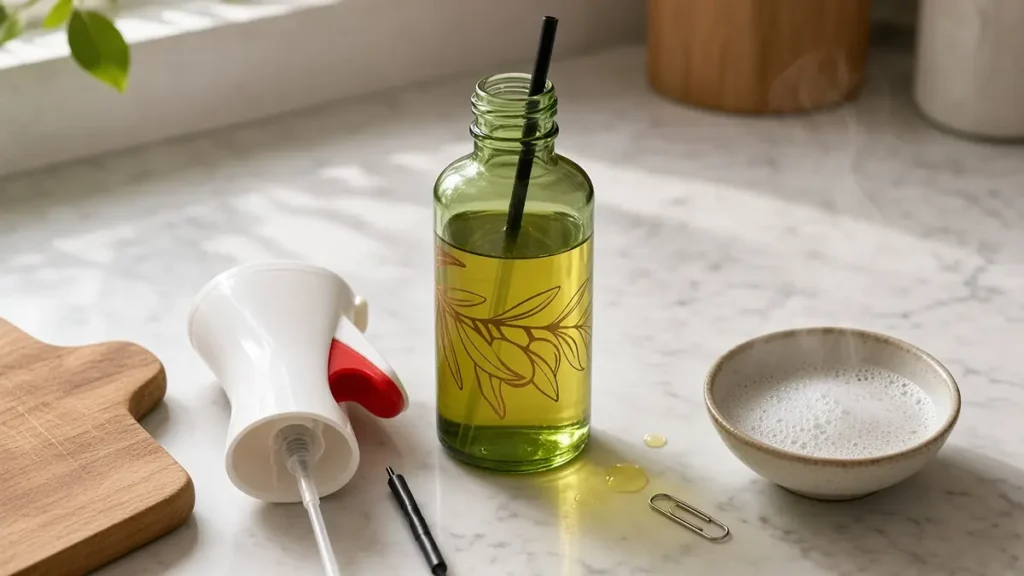
My oil sprayer gave up on a Tuesday, halfway through a tray of vegetables — one minute it was throwing a fine, even mist, the next it was dribbling a thin stream down the side of the bottle. If your oil sprayer is not working, whether it is an oil mister not working, a pump spray bottle for cooking oil that quit, or an olive oil sprayer not working after a few weeks in the cupboard, this is the fix list that actually earns its keep.
It did not need binning. It needed about ten minutes and a kettle. Since then I have taken apart enough of these — trigger sprayers, pressurised misters, the cheap ones and the good ones — to know which fixes actually clear a clogged nozzle and which ones just waste an evening. This is the order I work in, starting with the one that solves most clogs on its own.
Quick answer, if that is all you have time for: fill the bottle halfway with hot tap water, add a drop of dish soap, and spray it through into the sink fifteen times. That alone fixes the majority of them. Everything below is for when it does not.
How we know this
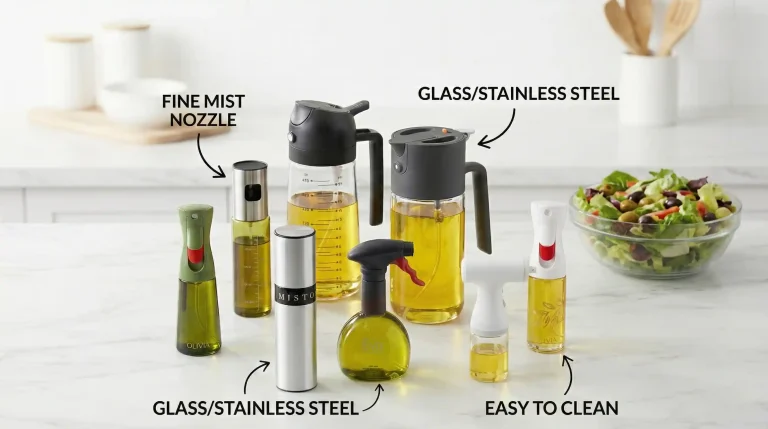
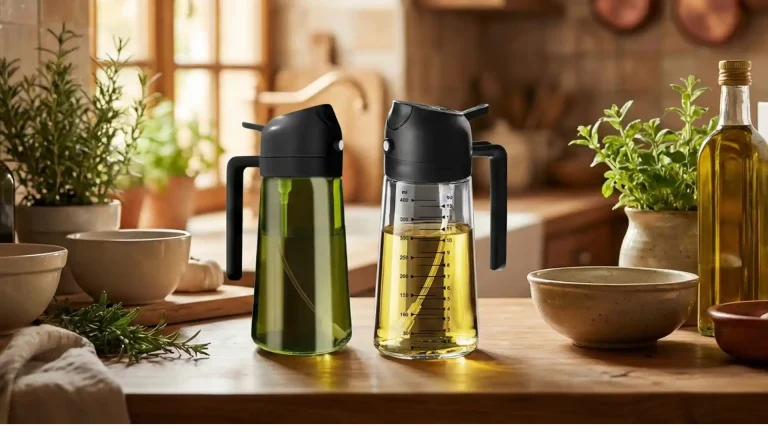
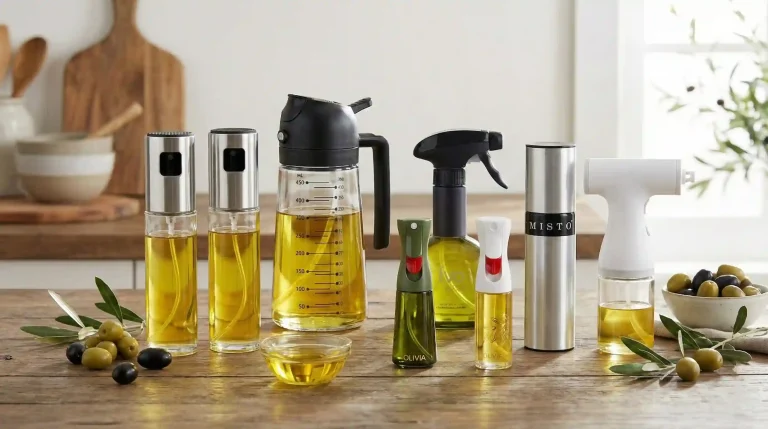
Everything on this page comes from units we bought, used and stripped down for our reviews: the Flairosol Olivia, the EVO 18-ounce, the TrendPlain 2-in-1 and a pressurised Misto, plus the eight sprayers compared in our best oil sprayer roundup. Where a manufacturer publishes care instructions, we follow and cite them rather than inventing our own — see Sources at the bottom.
Why oil sprayers stop working in the first place
Two things are happening at once, and knowing which one you have saves a lot of time.
The first is oxidation. Oil left sitting in the narrow channel of a nozzle slowly thickens. What started as a liquid turns into something closer to varnish, and varnish will not rinse away with cold water. This is why an oil sprayer clogs after a few weeks of neglect rather than all at once — the film builds in layers.
The second is solids. Unfiltered oils carry microscopic particles: olive fruit in a cloudy extra virgin, herb flecks in an infused oil, sediment in anything unfiltered. Those particles get filtered out by the narrowest point in the mechanism, and the narrowest point is the nozzle. It is the usual suspect when an olive oil sprayer stops working even though the pump feels fine. Good sprayers solve it with a built-in anti-clog filter at the base of the intake tube; the ones without one clog far more often.
Temperature makes both worse. Unfiltered extra virgin olive oil contains natural waxes that begin to cloud and stiffen well below room temperature — UC Davis notes this cloudiness is natural and not a sign of bad oil — and coconut oil solidifies outright under about 24°C (76°F). If your kitchen runs cold, or the bottle lives near a window, you are handing the nozzle a head start.
Pressurised misters — the Misto style, where you pump to build pressure — have a third failure mode that trigger sprayers do not: they can lose pressure without being clogged at all. The fix is completely different, so diagnose before you soak anything.
Diagnose it first: two minutes, four checks
Most of the bad advice online comes from people treating every sprayer failure as a clog. Run these checks and you will know which of the nine fixes you actually need.
| What you see | What it usually means | Go to |
|---|---|---|
| Trigger moves normally, thin stream comes out | Partly clogged nozzle | Fix 1 |
| Nothing comes out, trigger feels fine | Fully clogged, or dip tube detached | Fix 1, then 2 |
| Trigger is stiff or will not return | Lock clip engaged, or seized pivot | Fix 6 |
| Pump hisses, pressure will not build | Failed gasket, not a clog | Fix 8 |
| Sprays fine, then stops after two pumps | Vent hole blocked or bottle overfilled | Fix 3 |
| Brand new, never sprayed properly | Simply not primed yet | Fix 5 |
| Works at some angles, not others | Dip tube kinked or too short | Fix 8 |
One warning before anything else. If the trigger feels stiff, do not force it. Forcing a trigger against resistance does not clear clogs. It strains the spring, compresses the rubber gaskets unevenly, and can crack the dip tube. A cracked dip tube means a permanent air leak and a sprayer that will never mist properly again — which is how a ten-minute cleaning job becomes a replacement purchase.
Diagnosis Flowchart
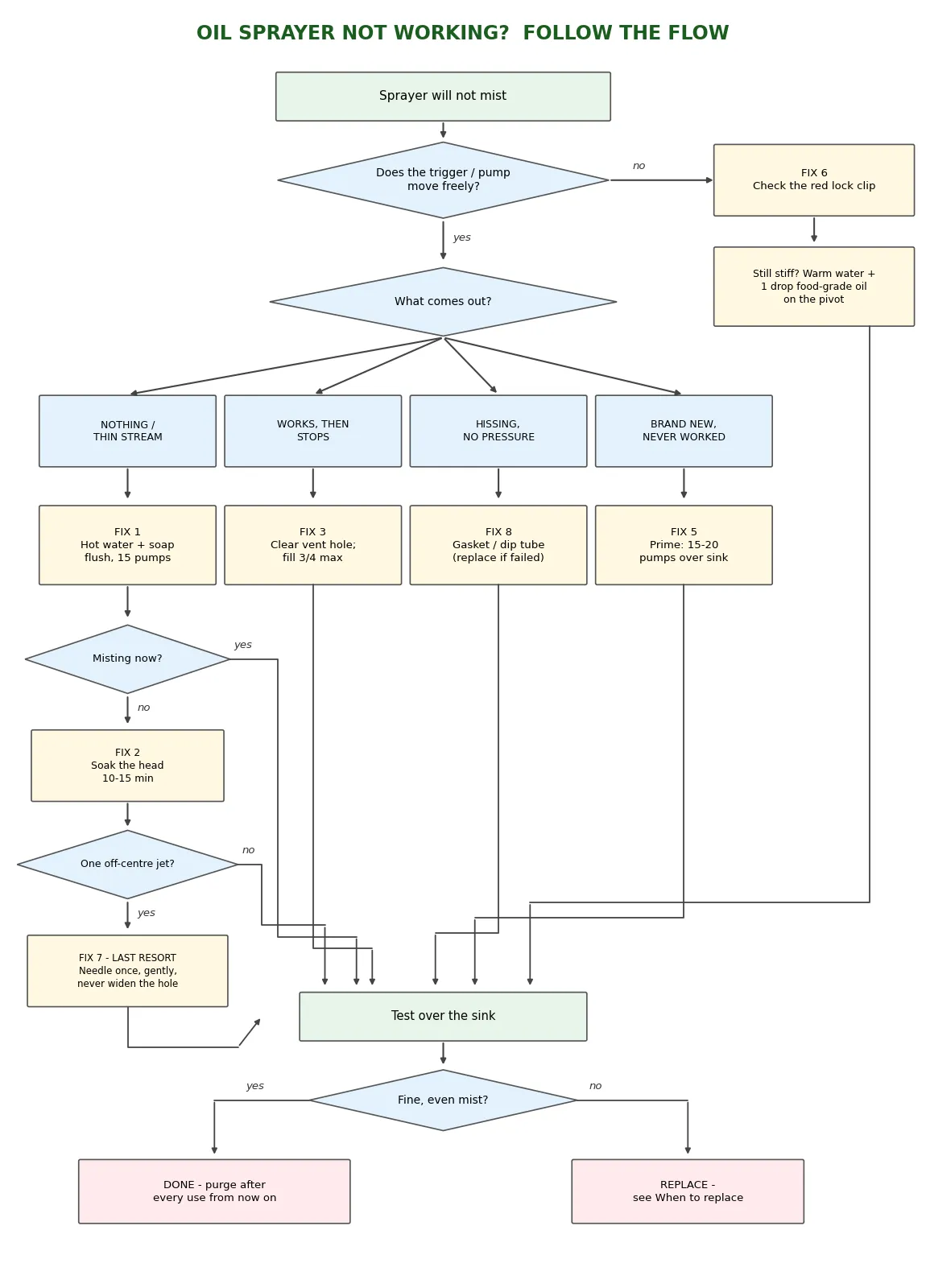
The nine fixes, in the order I use them
Fix 1: the hot water and soap flush
The nine fixes, in the order I use them
Fix 1: the hot water and soap flush
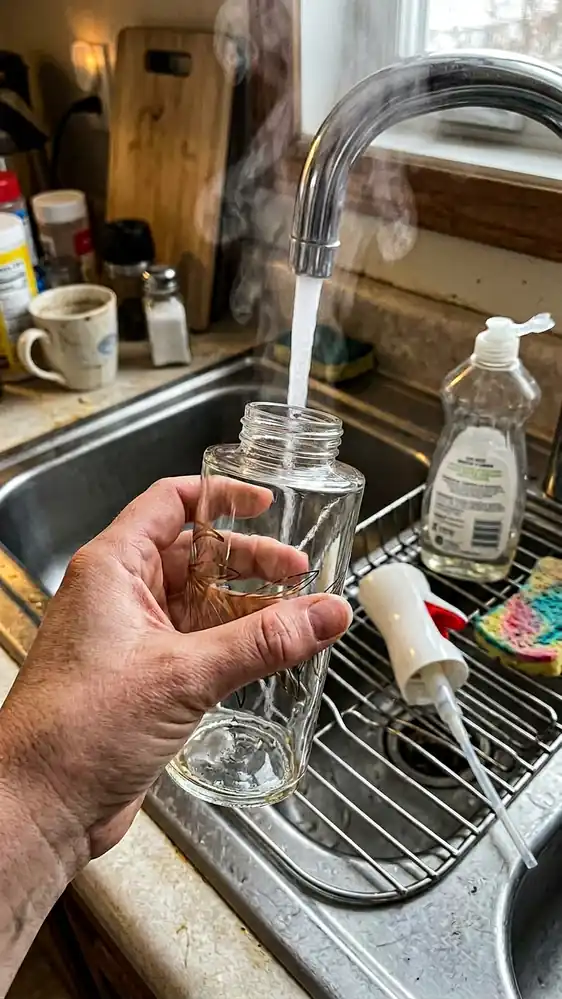
This is the quickest way to clean a clogged oil sprayer, it clears most clogs on its own, and it is the only step most people will ever need.
- Pour the remaining oil back into its bottle or a small jar. Do not pour it down the sink.
- Fill the bottle about halfway with the hottest water your tap delivers. Not boiling. Boiling water warps plastic bodies and softens rubber seals. Hot tap water, roughly 50–60°C, is the sweet spot.
- Add one or two drops of dish soap. A grease-cutting formula works best here.
- Reassemble, tighten the collar properly, and shake.
- Spray into the sink repeatedly — ten to fifteen pumps — until the pattern looks like a spray again.
- Empty, refill with clean warm water, and spray through until no suds remain.
For a pressurised mister, the same sequence applies but you must let it sit for a few hours or overnight. The dwell time is what breaks down oil that has properly solidified. Rushing this is the most common reason people conclude the method does not work. (This matches Misto’s own manual, which prescribes hot tap water plus one drop of detergent — see Sources.)
Fix 2: soak the nozzle head from the outside
If flushing did not do it, the residue is in the head rather than the body. Stop trying to push it through and start dissolving it from the other side. Unscrew the head, drop it and the dip tube into a mug of hot-not-boiling water for ten to fifteen minutes, then reassemble and pump. Two short soaks beat one long one, because the water cools.
Fix 3: clear the vent hole and check the fill line
This one gets missed almost every time. Many sprayers have a tiny vent hole that lets air into the bottle as oil leaves. Block it and the bottle forms a partial vacuum: the sprayer works for two pumps and then stops dead, which looks exactly like a clog. Related, overfilling a pressurised mister leaves no headspace to build pressure — Misto’s manual is blunt about filling only halfway for exactly this reason. Empty it to about three-quarters and try again before you assume anything is broken.
Fix 4: about vinegar, honestly
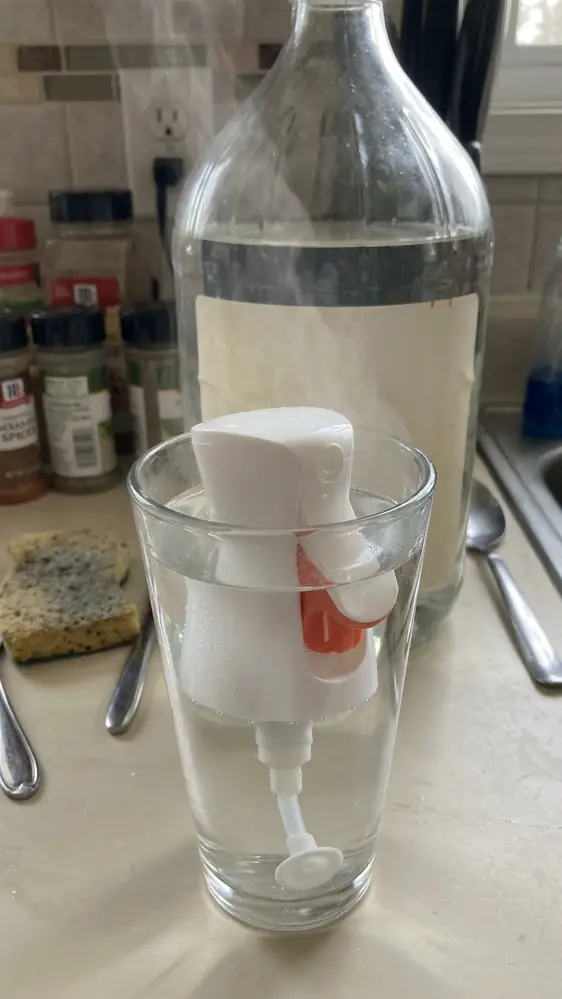
Every guide tells you to soak the nozzle in vinegar, so it is worth being straight about what it does and does not do. Vinegar is an acid in a water base; oil is not water-soluble, so vinegar does not dissolve hardened oil well — the hot water and soap in Fix 1 do the real work. Where vinegar genuinely helps is mineral scale from hard water. So in a hard-water area, a fifty-fifty hot water and white vinegar soak for fifteen minutes is worth doing after the soap flush. In a soft-water area, skip it. And note: repeated vinegar soaks corrode the small metal springs and dry out rubber gaskets, so keep it occasional.
Fix 5: prime the pump
If the sprayer is new, or you have just cleaned and refilled it, the dip tube is full of air. Nothing is broken. Pump it fifteen to twenty times over the sink and the oil will start to draw. If it is still hissing after ten pumps, the bottle is not holding air and you have a seal problem, not a priming problem — go to Fix 8.
Fix 6: free a seized trigger or stuck lock
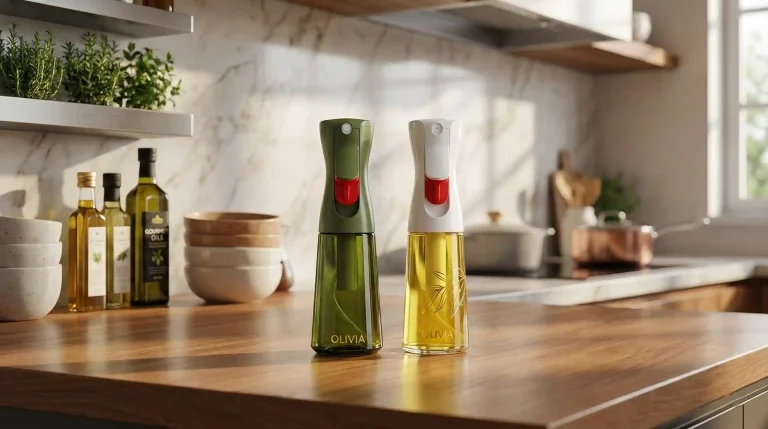
Before you take anything apart, check whether your sprayer has a trigger lock and whether it is engaged — on the Flairosol Olivia it is a small red clip behind the trigger, and it is remarkably easy to nudge into place while wiping the bottle down; a locked trigger feels exactly like a broken one. If it is genuinely seized, run warm water through the pump head while repeatedly pulling the trigger, then add one drop of food-grade mineral oil on the pivot. Do not use WD-40 or anything not rated food-safe.
Fix 7: the needle — and the mistake that ruins a sprayer
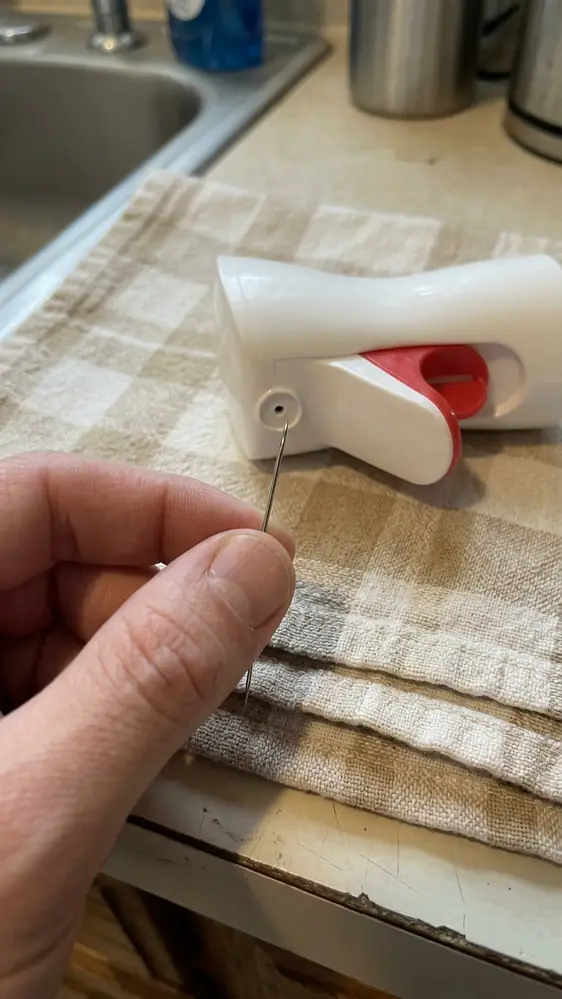
If the spray still comes out as a single off-centre jet after all of the above, a solid particle is wedged in the orifice and no soak will move it. This is where a fine sewing needle comes in, and it is the step I reach for last, deliberately.
Here is the part that matters. The orifice is precision-sized, and enlarging it ruins the sprayer permanently. That tiny hole is what atomises the liquid. Make it even slightly wider and the mist becomes a stream forever. So: hold the head under a light, insert the needle straight in, rotate it gently once, do not jab. Rinse under warm running water while holding the trigger down, reassemble and test. Do not use compressed air.
Fix 8: replace the gasket, or accept the sprayer is finished
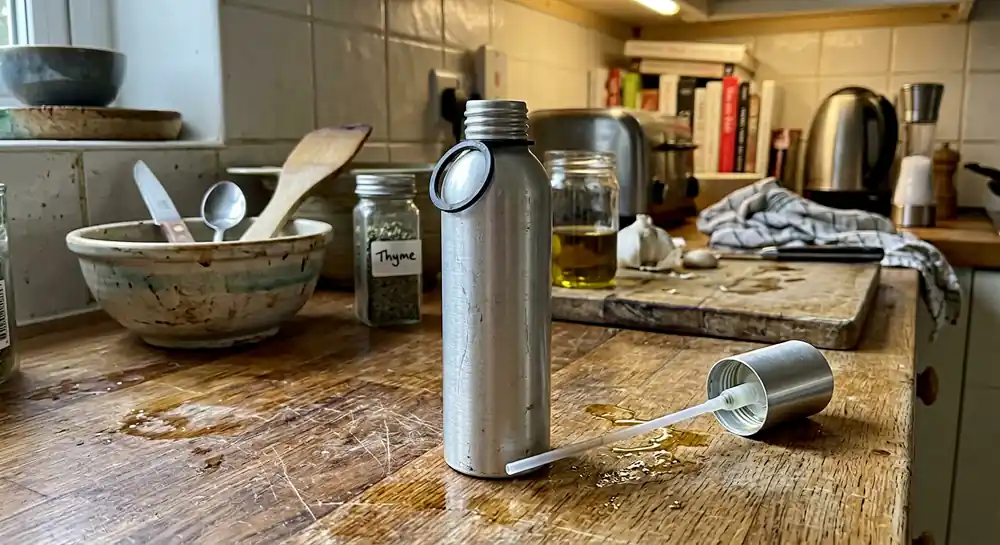
A pressurised mister that hisses and loses pressure with the collar fully tightened has a failed gasket. Check the black rubber ring where the pump assembly meets the bottle — it slips off easily during cleaning. If the ring is intact but hardened, replacements are rarely sold separately, which is the point at which I stop. The same goes for a kinked or cracked dip tube.
Fix 9: change the oil

If you are constantly fighting clogs, some oils are simply better suited to spraying. Unfiltered extra virgin is the worst offender — solids and waxes in exactly the combination that blocks a nozzle. Filter the oil on the way in through a coffee filter over a funnel; it takes thirty seconds. We covered the oil question properly in our guide on how to choose an olive oil sprayer that lasts.
Brand by brand: what usually goes wrong
Autocomplete shows people search for this problem by brand — misto oil sprayer not working, evo oil sprayer not working, flairosol olivia not spraying. The causes are genuinely different, so here is what to check first on each.
| Brand | Mechanism | Anti-clog filter | Lock | What fails first |
|---|---|---|---|---|
| Flairosol Olivia | Trigger mister | Yes — sleeve on intake tube | Red clip on trigger | Lock clip engaged; worn seal |
| Misto | Pressurised mister | No — removable nozzle | None | Lost pressure; gasket |
| EVO 18 oz | Trigger sprayer | No | None | Residue in trigger pivot |
| TrendPlain 2-in-1 | Trigger + pour spout | Built-in filter | None | Spray channel only |
- Misto and pressurised misters: pressure problems beat clogs. Work the collar and gasket first, and follow the manufacturer’s hot-water-and-detergent standing-time exactly.
- EVO and trigger sprayers: these produce a defined fan, so a slightly uneven pattern is normal; a hard stream is not. The usual fault is residue in the trigger pivot. See our full EVO review.
- Flairosol Olivia: the built-in filter makes genuine clogs uncommon. When one fails it is usually the red lock clip or a worn seal. Check the lock, then soak the head. Our Flairosol Olivia review covers the mechanism in detail.
- TrendPlain and 2-in-1 sprayers: if the pour spout works but the spray does not, the blockage is in the spray channel specifically. Our TrendPlain review explains how the two functions are routed.
Five habits that stop clogs coming back
- Purge after every use. Two or three empty pumps over the sink expel the oil sitting in the nozzle so it is not left there to harden. If you adopt one habit, make it this one.
- Store it upright. Laying a sprayer on its side lets oil pool in the pump chamber.
- Filter the oil going in. A coffee filter over a funnel, thirty seconds.
- Do not overfill. Leave the headspace the manufacturer specifies.
- Rinse monthly. Warm water and a drop of soap, sprayed through, every three to four weeks with daily use. Fortnightly for infused or unfiltered oils.
When to stop repairing and start replacing
Sprayers are cheap enough that time is the real cost. I stop when I hit any of these:
- The spray pattern stays wrong after a needle clean — the orifice has been enlarged.
- A pressurised mister hisses and loses pressure with the collar tightened and an intact gasket.
- The dip tube is kinked or cracked.
- The oil smells rancid no matter how thoroughly you clean it.
If you have reached that point, our rundown of the best oil sprayers we have tested is where I would start.
The sprayer I have used longest and the one I would buy again: Check the current price of the Flairosol Olivia
Frequently asked questions
Sources
- Misto owner’s manual — cleaning method (hot tap water, one drop of detergent), the halfway fill rule, and the six-to-eight-week cleaning interval.
- UC Davis, “Olive Oil Myths and Facts” — cloudiness and sediment in olive oil come from natural waxes and are not a sign of spoilage; the same waxes are what stiffen in a cold nozzle.
- Flairosol official product page — Olivia specifications and variants.
- Our own hands-on reviews, linked throughout, whose photographs we used for verification while preparing this guide.

Senior Reviewer & Writer
Mary James is an enthusiast reviewer & writer at Top Gears Hub. She is the reviewer you want before you buy your next piece of kitchen kit. She cuts through the hype with a healthy dose of real world cooking. Whether it is a new non stick pan or a high tech oven, she tests it all with a cook’s intuition for detail. Her mission is simple: to give you the clear and honest lowdown so you can spend your money wisely and get back to the joy of cooking.